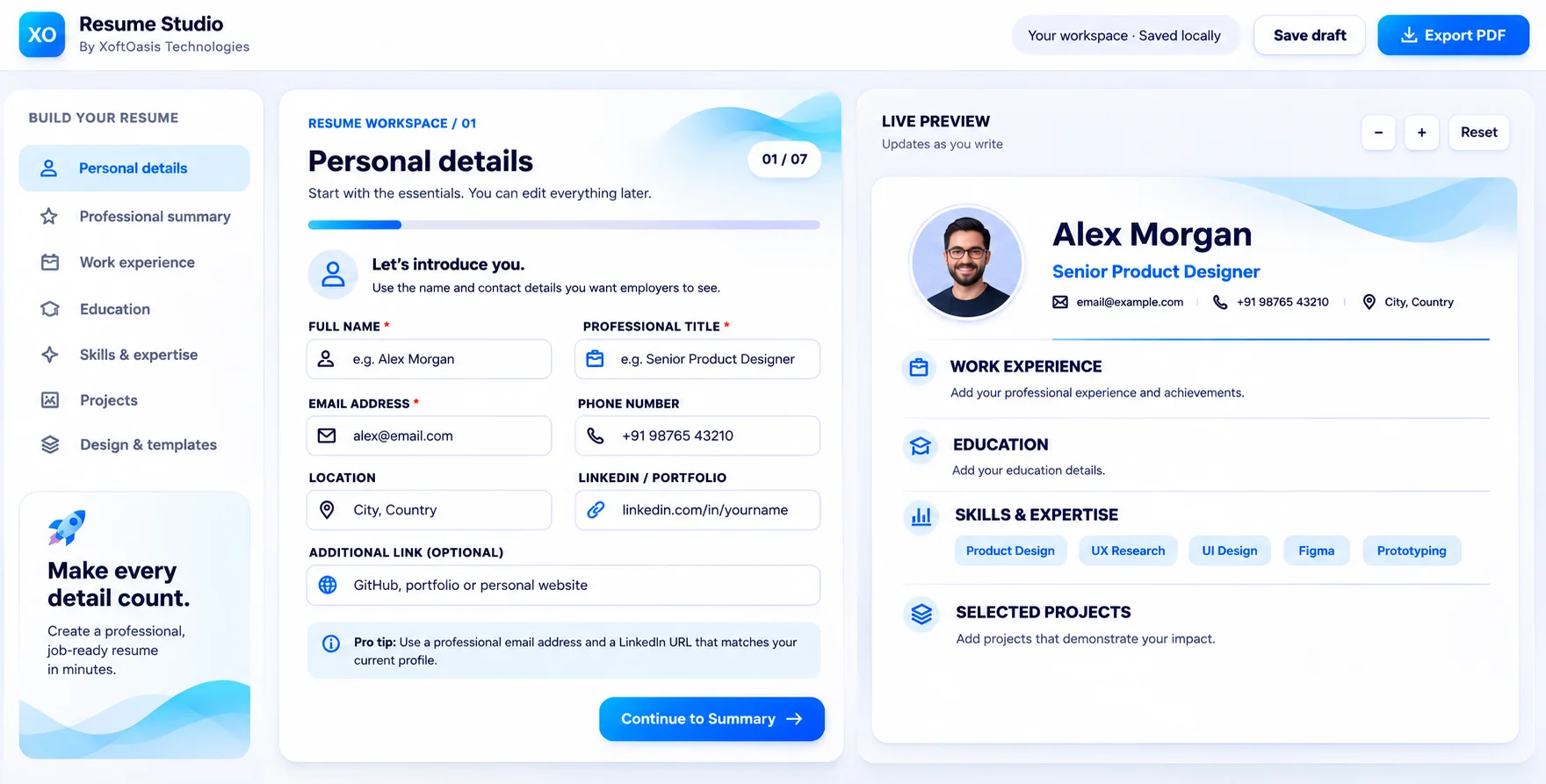
In brief: Employers cannot meet every candidate personally. A resume helps them quickly understand whether a person has relevant skills, experience, achievements, and career direction. It does not guarantee an interview, but a clear and relevant resume makes it easier for recruiters and hiring managers to consider you.
Ready to create your resume? Open XO Resume Studio.
1. Why a resume matters in a job search
A resume is usually the first structured record of your professional fit. For employers, it answers three early questions: Can this person perform the work, is the person credible, and does the application appear relevant to the vacancy?
A strong resume makes it easier for the reader to find answers. It presents career information in a predictable order, highlights relevant skills, and gives the person reviewing the application a reason to continue.
That importance is especially visible when many candidates apply for one role. Recruiters may spend only a short time on an initial scan, while hiring managers may receive large numbers of applications. A clear resume helps them identify relevant experience instead of overlooking a capable candidate because the information is difficult to find.
2. What employers look for
Employers use a resume to assess fit, but the exact priorities depend on the role. Some vacancies emphasize formal qualifications, regulated experience, or technical skills. Others may place greater weight on communication, reliability, portfolio work, or a record of learning quickly.
- Relevant experience: Work, projects, internships, volunteering, or studies that relate to the role.
- Clear responsibilities: What you were expected to do, rather than vague statements such as “worked on projects.â€
- Proof of impact: Results that show accuracy, improvement, growth, efficiency, customer value, or learning.
- Required skills: The tools, methods, certifications, or capabilities named in the job description.
- Professional presentation: Consistent formatting, correct contact details, readable language, and no avoidable distractions.
- Career logic: A clear explanation of the direction you are moving toward and why this opportunity fits.
The goal is not to claim that you have every skill. It is to show the evidence that is most relevant to a specific employer and role.
3. How to build a strong resume
Start with the job requirements
Read several recent descriptions for the role you want. Identify the repeated responsibilities, tools, qualifications, and working conditions. Then include honest evidence that matches the strongest requirements.
Use a clear structure
- Header: Name, professional title, city or region, phone number, email address, and a relevant portfolio or LinkedIn link.
- Professional summary: A short statement explaining your target role and strongest relevant experience.
- Skills: A focused list of capabilities relevant to the vacancy.
- Experience: Paid work, internships, freelance assignments, or relevant projects with the outcome described.
- Education and certifications: Qualifications that support the role, presented clearly and accurately.
- Projects or additional sections: Useful when they provide stronger evidence than formal work experience.
Write results instead of duties
A duty statement describes what you were assigned. An achievement statement explains what changed because of your work. Use numbers when they are accurate and meaningful.
- Instead of: “Responsible for customer emails.â€
- Try: “Managed a daily customer email queue, documenting responses and reducing unresolved queries by 18% over three months.â€
- Instead of: “Worked on an e-commerce website.â€
- Try: “Built and tested a responsive product page that improved form completion during a supervised project.â€
Tailor each application
Adjust the summary, selected skills, and experience order to reflect the role. Keep the factual record consistent, but emphasize different evidence for different opportunities. Do not copy a job description or add skills you cannot explain in an interview.
4. Resume screening and human review
Some organizations use applicant tracking systems or automated filters before a person reviews the resume. These tools vary greatly, so a readable, conventional format is safer than an overly decorative design.
- Use standard headings and a logical reading order.
- Save the resume as a PDF unless the employer requests another format.
- Include normal written names for skills and roles.
- Do not place important information only inside images or charts.
- Do not rely on hidden keywords or exaggerated claims.
A hiring manager still evaluates credibility, relevance, communication, and career logic. The resume should help that person ask better questions in an interview—not make every claim for you.
5. Common resume mistakes
- Using one generic resume for every role: The strongest evidence may be buried below less relevant information.
- Listing every task instead of the result: A long duty list can hide what you actually achieved.
- Using vague phrases: “Hardworking team player†does not explain a skill or provide evidence.
- Exaggerating experience: Incorrect claims become difficult to support during screening or interviews.
- Ignoring gaps, however unexplained: Prepare a truthful, brief explanation when the timeline raises questions.
- Making it unnecessarily long: Early-career resumes are often clearer in one or two pages, but length should follow the role and experience.
- Including sensitive personal information: Only add details required by the employer or local application process.
- Sending an unreviewed document: Check names, dates, links, spelling, consistency, and file name before applying.
Frequently asked questions
Is a resume really necessary if I have a LinkedIn profile?
Usually, yes. LinkedIn and a resume serve different purposes. A resume is easier to tailor to a vacancy and provide to an employer in a controlled, consistent format.
How long should a resume be?
For most entry-level and early-career applicants, one or two focused pages is enough. More experienced candidates may need additional space, but relevance and clarity matter more than a fixed length.
What if I do not have work experience?
Include relevant projects, internships, volunteering, coursework, training, freelance work, community activity, or responsibilities that demonstrate useful skills. Explain what you did and what you produced.
Should I include all software tools I have used?
No. Include tools that are relevant to the role and that you can explain honestly. A short, organized skills section is usually more useful than an exhaustive list.
Build a resume that supports your next step
Use a clear structure, tailor the evidence, and present each application honestly.
Explore XO Resume Studio Talk to our team